Best Open-Back Headphones at Every Budget

Updated · Researched and written by Elan Harpaz · How we pick

Short answer

For most people the best open-back headphone is the Sennheiser HD 560S, $199.95 when we checked it on 2026-08-03. One pair to mix on, game on and listen to, driven by a dongle rather than a desktop amp.

Best on a budget:
Philips SHP9500 ($99.99 on 2026-08-03). A first open-back for someone who owns no amp and does not want to buy one.
Best for most people:
Sennheiser HD 560S ($199.95 on 2026-08-03). One pair to mix on, game on and listen to, driven by a dongle rather than a desktop amp.
Best if you want the most:
Sennheiser HD 600 ($272.49 on 2026-08-03). Listeners who already own an amp and want a midrange reference they will keep for a decade.

Researched, not tested: we have not handled these products. Verdicts come from published specs, owner reviews read at volume, and our own weekly price record. No paid placements, and commissions never change our rankings.

Open-back headphones make a trade. You give up isolation, and in return you get a wide, speaker-like soundstage and a more natural, uncolored sound that closed cans struggle to match. They leak audio both ways, so they are built for a quiet room and useless on a train.

The three below are the wired open-backs the hi-fi community has converged on over roughly a decade, and they line up as a single upgrade path rather than three rival brands. What separated them:

  • Tuning: how close each sits to a neutral reference, and where it deviates
  • Drive requirements: impedance and sensitivity decide whether a laptop jack is enough
  • Serviceability: pads, cables and headbands you can replace instead of binning the headphone
Editor's Choice

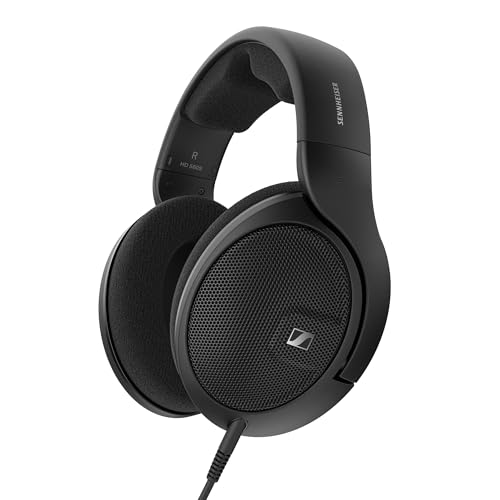
Sennheiser HD 560S Open-Back Over-Ear Wired Headphones – Neutral, Natural Sound for Music, Gaming, and Content Creation, Black

Best for: One pair to mix on, game on and listen to, driven by a dongle rather than a desktop amp.

Reference tuning at 120 ohms and 110 dB, which is the rare combination of honest and easy to drive.

$199.95 observed

Check price on Amazon

Our take

These three are one ladder, not three options. The HD 560S is the one worth most people's money: at 120 ohms and 110 dB it plays loud from a laptop jack or a cheap dongle, and Sennheiser tunes it flat rather than flattering, which is what a single do-everything pair should be. The SHP9500 is the cheaper way in. At 32 ohms and 101 dB it genuinely needs nothing else, and its rolled-off sub-bass is the price of that. The HD 600 is 300 ohms at 97 dB, so an amp is part of its cost rather than a later upgrade, and what you buy with it is midrange accuracy plus a parts catalog that keeps the headphone alive for a decade.

What we do not cover: the planar-magnetic side of this category, where the HiFiMan Sundara and Edition XS are the usual recommendations at similar money. Neither is in our catalog, so neither is ranked here.

Basis: published specs, the complaints and praise that recur across owner reviews, and the prices we have recorded weekly for all three since 2026-06-24. We have not listened to them. Ratings score each product on the merits with price left out, so the premium pick always sits highest. The tier tells you where a pick sits on price, not how good it is.

How to choose open-back headphones

Open-back headphones all make the same core trade, so the choice comes down to a few honest questions:

  • Your room: open-backs leak sound both ways. If you share a space or commute, these are the wrong tool. They shine in a quiet room you have to yourself.
  • Amplification: check impedance and sensitivity together. Around 32 ohms at 100 dB or more runs off a laptop. At 300 ohms and 97 dB, a phone jack will not reach a satisfying volume, let alone control the driver.
  • Sound signature: a brighter, detail-forward tuning suits mixing and competitive gaming. A warmer, more relaxed tuning is easier over a long evening.
  • Comfort: clamp force and pad material decide a long session more than weight does. Velour and large cloth pads breathe, pleather warms up.
  • Parts: a detachable cable is the single most useful durability feature, because the cable is what fails first. Replaceable pads matter next, since foam collapses in two to three years of daily use.

Spend on the driver, not the accessories. Pads and cables are cheap to upgrade later.

At a glance

Best Open-Back Headphones at Every Budget compared

Philips Audio SHP9500 HiFi Precision Stereo Over-Ear Headphones (Black), Sennheiser HD 560S Open-Back Over-Ear Wired Headphones – Neutral, Sennheiser HD 600 - Audiophile Open-Back Dynamic Wired Headphones Over Ear with Natural Soundstage and Premium Comfort for Music Lovers compared on tier, price, our rating, and who each one is for.
PickTierPrice, and when observedOur ratingBest for
Philips Audio SHP9500 HiFi Precision Stereo Over-Ear Headphones (Black)Budget Pick$99.99 on 2026-08-037.8 / 10A first open-back for someone who owns no amp and does not want to buy one.
Sennheiser HD 560S Open-Back Over-Ear Wired Headphones – NeutralBest Value$199.95 on 2026-08-038.6 / 10One pair to mix on, game on and listen to, driven by a dongle rather than a desktop amp.
Sennheiser HD 600 - Audiophile Open-Back Dynamic Wired Headphones Over Ear with Natural Soundstage and Premium Comfort for Music LoversPremium Pick$272.49 on 2026-08-039.2 / 10Listeners who already own an amp and want a midrange reference they will keep for a decade.

The full breakdown

Budget Pick7.8 / 10

Philips Audio SHP9500 HiFi Precision Stereo Over-Ear Headphones (Black)

Best for: A first open-back for someone who owns no amp and does not want to buy one.

The SHP9500 is the headphone people keep pushing on anyone curious about hi-fi who does not want to spend real money, and the reason is specific: 32 ohms at 101 dB is easy enough that a phone or laptop output drives it properly, so the headphone is the whole purchase. That is not true of anything else in this guide.

Its character is a wide, open stage with sharp left-to-right placement, which is why it has a long tail as a competitive-gaming headphone and why detail-hunters use it to pull a mix apart. The 50mm drivers sit angled in a large, shallow cup, and the cloth pads breathe well enough that summer sessions do not get sticky.

The deviation from neutral is at the bottom. Sub-bass rolls off audibly below about 60 Hz, so kick drums land as a tap rather than a thump, and electronic music loses its floor. Treble sits forward enough that a poorly mastered recording can turn edgy. The cable detaches, which matters more than it sounds: the stock cable is long, thin and the part owners replace first.

What we like

  • + Reaches proper listening volume from a laptop or phone jack, so no amp purchase is implied
  • + Places instruments and footsteps across a wide stage, which is why it persists as a gaming pick
  • + Large cloth pads stay cool through multi-hour sessions
  • + Detachable cable turns the most common failure into a cheap swap

Watch outs

  • - Sub-bass rolls off audibly, so bass-led genres sound thin without EQ
  • - Treble edge shows up on compressed or badly mastered tracks
  • - Plastic headband and yokes flex noticeably, and the grille is exposed to knocks
  • - Leaks so much sound that anyone in the room hears your music

Full specs

Driver50mm dynamic, angled
Back typeOpen-back
Impedance32 ohms
Sensitivity101 dB
Frequency response12 Hz - 35 kHz
CableDetachable, 3.5mm + 1/4" adapter
PadsBreathable cloth
Weight320 g
SoundNeutral, slightly bright
Best ValueEditor's Choice8.6 / 10

Sennheiser HD 560S Open-Back Over-Ear Wired Headphones – Neutral, Natural Sound for Music, Gaming, and Content Creation, Black

Best for: One pair to mix on, game on and listen to, driven by a dongle rather than a desktop amp.

The HD 560S is what the SHP9500 owner buys next. Sennheiser tuned it close to a diffuse-field reference rather than to a shop demo, so vocals sit where the engineer put them and a bad mix sounds bad. That is the point of it.

The practical argument is the drive spec. At 120 ohms and 110 dB it plays loudly and stays controlled from a phone dongle or a PC jack, which is unusual for a headphone tuned this honestly. A small amp tightens the bass and adds headroom, but the headphone is not waiting on one to be usable.

Bass extends flatter than the Philips does, but it is deliberately unexaggerated, so anyone coming from a consumer tuning will read it as thin for the first week. Treble is lifted slightly around the presence region, which reads as clarity on good recordings and as glare on harsh ones. The build is almost entirely plastic and the headband creaks when you adjust it, though the velour pads and the low clamp make it the most wearable of the three over a full workday.

What we like

  • + Honest enough to mix on, so decisions made here translate to other systems
  • + Reaches reference volume from a dongle, which removes the amp from the buying decision
  • + Low clamp and velour pads make it the easiest of the three to wear all day
  • + Detachable cable and replaceable pads, both stocked as spares by Sennheiser

Watch outs

  • - Deliberately flat bass reads as thin until your ears recalibrate, which takes days not minutes
  • - Presence-region lift turns into glare on bright or compressed recordings
  • - All-plastic construction creaks under adjustment and feels cheaper than it sounds
  • - Open back means everyone near you hears it, and you hear them

Full specs

Driver38mm dynamic
Back typeOpen-back over-ear
Impedance120 ohms
Sensitivity110 dB SPL
Frequency response6 Hz - 38 kHz
CableDetachable, 3.5mm + 6.3mm adapter
PadsVelour, replaceable
WeightApprox 240 g
SoundNeutral reference, slight presence lift
Premium Pick9.2 / 10

Sennheiser HD 600 - Audiophile Open-Back Dynamic Wired Headphones Over Ear with Natural Soundstage and Premium Comfort for Music Lovers, Open Metal Earpiece Covers, Black

Best for: Listeners who already own an amp and want a midrange reference they will keep for a decade.

The HD 600 has been the headphone other headphones get measured against since 1997, and the reason is narrow and real: its midrange is close to neutral across the range where voices and acoustic instruments live, with none of the scooping or presence spikes that flatter a demo and annoy you later.

This is the one pick that will not work without an amp. At 300 ohms and 97 dB, a phone runs out of voltage well before the headphone runs out of dynamics, so it sounds quiet, soft and flat straight from a laptop. Fed properly it snaps into focus. Plan for a desktop amp or a powerful dongle at the same time as the headphone.

The compromises are the other side of the same tuning. Sub-bass rolls off, so this is not the headphone for bass-led electronic music. The stage is intimate rather than cavernous, which some listeners prefer and others find closed-in. Clamp force out of the box is strong enough that the first fortnight is uncomfortable on a wide head. Against that, Sennheiser still sells pads, headband cushions, grilles, yokes and cables individually, which is why decade-old pairs stay in service instead of being replaced.

What we like

  • + Midrange accuracy that still holds up as a reference against far newer designs
  • + Pads, headband, grilles, yokes and cable are all individually replaceable and still stocked
  • + Low weight and velour pads make long sessions easy once the clamp relaxes
  • + Standard 2-pin connectors give it a large third-party cable market

Watch outs

  • - Sounds quiet and lifeless from a phone or laptop, so an amp is a required purchase, not an upgrade
  • - Sub-bass roll-off leaves bass-led electronic music without a floor
  • - Clamp force is genuinely tight for the first few weeks on a wide head
  • - Intimate stage feels closed-in next to the SHP9500 or HD 560S

Full specs

Driver40mm dynamic
Back typeOpen-back
Impedance300 ohms
Sensitivity97 dB SPL
Frequency response12 Hz - 40.5 kHz
CableDetachable, 2-pin + 6.3mm adapter
PadsVelour, replaceable
Weight260 g
SoundNeutral, midrange-reference

Compare these head to head

Frequently asked questions about open-back headphones

Do open-back headphones need an amp?

It depends on impedance and sensitivity together, not on the words open-back. The SHP9500 (32 ohms, 101 dB) and HD 560S (120 ohms, 110 dB) reach full volume from a phone or laptop. The HD 600 does not: 300 ohms at 97 dB needs a dedicated amp or a high-voltage dongle before it sounds like itself.

Are open-back headphones good for gaming?

Yes, and specifically for positional audio. The wide stage makes footsteps and directional cues easier to place, which is why the SHP9500 has stayed a gaming recommendation for years. The catch is that they leak in both directions, so a desk mic will pick up your game audio.

Can other people hear my open-back headphones?

Yes. Open-backs leak by design, and at normal listening volume someone sitting next to you can follow the track. They are a poor choice for offices, libraries, shared bedrooms and any commute.

Open-back or closed-back, which should I buy?

Open-back for the widest stage and most natural sound in a room you control. Closed-back if you need isolation, privacy, or a microphone in the same room. Every pick in this guide is open-back, so if isolation matters, our studio headphones guide is the right page.

Is the Sennheiser HD 560S better than the HD 600?

They are tuned similarly, and the honest answer depends on whether you own an amp. The 560S is wider, easier to drive and needs nothing else. The HD 600 has the more accurate midrange and a full spare-parts catalog, but only once it is amplified properly. Without an amp, the 560S wins outright.

More buying guides

We may earn a commission from qualifying purchases made through links on this page, at no extra cost to you. We only recommend products we would tell a friend to buy, and commissions never change our picks.